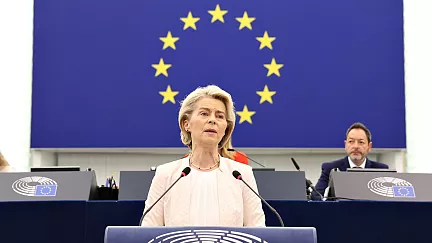
Brussels, November 17, 2025 – Total News Agency-TNA – The President of the European Commission, Ursula von der Leyen, urged this Monday the Member States of the European Union to reach a clear agreement before December to guarantee the financing of Ukraine's military and economic needs for the 2026-2027 period, estimated at approximately 135,000 million euros. The capacity of resistance of Kyiv depends as much on armaments as on external economic and logistical support; the uncertainty about financing compromises the sustainability of the effort. Although the three avenues are on the table, the difficulty of modifying budgetary rules, obtaining unanimity in the bloc, and deactivating internal resistance —such as that offered by Hungary or Belgium— make the path tortuous. In particular, the government of Belgium —where the main Russian assets are frozen in the Euroclear central securities depository— is reluctant to the plan that links those funds to a loan for Ukraine, for fear of economic or legal retaliation from Moscow. The Commission's letter underlines that the agreement must be reached before the December European Council summit, as it is intended that disbursements begin in the second quarter of 2026. This urgency reflects the critical juncture of Ukraine: the war with Russia continues without immediate prospects of a ceasefire, and its defense and state administrative system requires additional funds to sustain the war effort and the reconstruction simultaneously. Analysts agree that time is against them. The document contemplates three great avenues —or a combination of them— to complete the required financing: bilateral contributions from the member countries, joint debt issuance by the EU, and a loan based on the immobilized Russian assets. The first option is based on direct subsidies from the Member States, counted against their national budgets; the second involves EU debt with state guarantees; and the third proposes to link the repayment of a loan exclusively to the compensation that Russia can make for the damages caused. Financing thus becomes a test of credibility for the Union and its global role as a strategic actor in the face of Russian aggression. In practice, the Member States will have to evaluate which combination of instruments they will use, how they will distribute the fiscal burden, what guarantees they will demand, and how they will articulate a repayment mechanism based on Russian assets without violating principles of international law. As a bridging alternative, the letter suggests that subsidies and immediate debt could act as provisional solutions before the new EU budgetary framework comes into force in 2028. Meanwhile, for Ukraine and its allies, each day of delay represents a risk. According to the letter sent to the 27 national governments, “there are no easy options” and Europe cannot afford paralysis, due to hesitation or the search for perfect solutions that do not exist. Von der Leyen points out that the Ukrainian requirements present a “particularly acute” dimension: 83,400 million euros destined to finance the Army and another 55,200 million to stabilize the economy and cover the budget deficit. The latter formula could reach up to 140,000 million euros and avoid the direct tax burden on national budgets. The most critical obstacle to progress lies in the absence of consensus among the twenty-seven. Von der Leyen warns that if action is not taken “quickly”, the support for Ukraine will be compromised. The geopolitical background adds pressure: beyond military support, the stability of Ukraine is considered by the EU as a line of defense against a wider spread of the war in Eastern Europe. With the December summit as a key milestone, the result will mark not only the future of the war, but also the cohesion of the European project.