Today’s children, especially those living in low-income countries, will face a ‘unprecedented’ future, suffering the disproportionate consequences of climate change that no human generation has experienced before. In a 3.5 °C scenario, more than 90% will face this exposure throughout their lifetime, warns Grant.
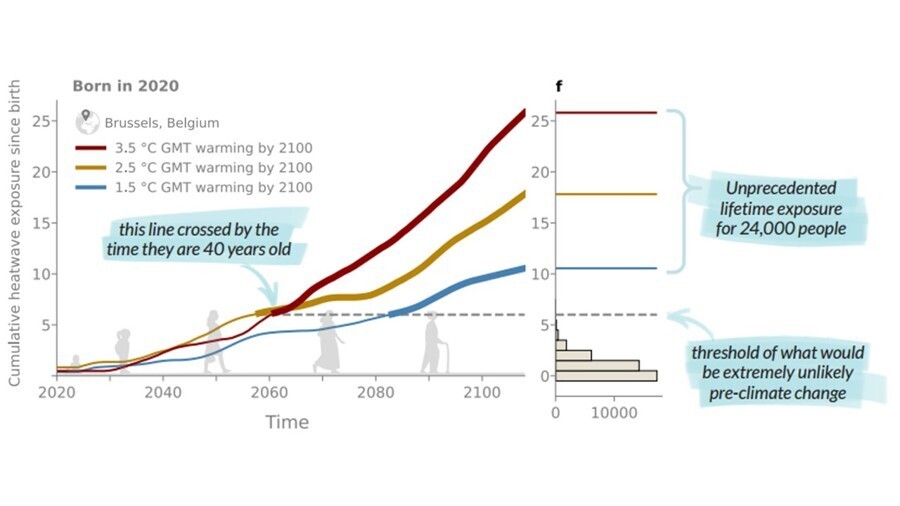
In the best-case scenario, if the world manages to limit global warming to 1.5 °C by the end of the century, around 52 percent of those born in 2020 (62 million people) will experience unprecedented exposure to heatwaves throughout their lives. However, if emissions raise global temperatures by 2.7 °C above pre-industrial levels, about one hundred million of the 120 million children born in 2020 will live in conditions never seen before.
These children will be victims of heatwaves, poor harvests, floods, tropical cyclones, droughts, and wildfires, consequences of continuing atmospheric warming that we have not been able or willing to curb. Children in tropical countries find themselves in a relatively worse situation in ambitious climate scenarios, while almost all children in the world will face unprecedented exposure to heatwaves throughout their lives in higher warming scenarios.
The difference between exceeding 1.5 °C or reaching 2.7 °C is that it would reduce the number of affected individuals by 38 million, people who could be saved from this disaster just by reducing fossil fuel use, according to the study. The authors explain that the consequences of global warming will be deadly for children and their physical and mental health.
Living an unprecedented life means that, without anthropogenic climate change, ‘one would have less than a one in 10,000 chance of experiencing so many climatic extremes throughout their life,’ points out Luke Grant, a scientist at VUB and Environment and Climate Change Canada (ECCC) and the lead author of the report. The children plead with us not to disconnect, denounces Inger Ashing, the CEO of Save The Children International.
Entering this climate crisis is not the children’s responsibility, but they are the ones who suffer the consequences the most. Dangerous heat, cyclones, droughts, and other extreme events affect their health, education, and future. With limited resources and adaptation options, they face disproportionate risks, laments Wim Thiery, Professor of Climate Science at VUB and the lead author of the study.